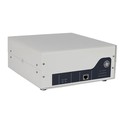
Yo, fellow lab enthusiasts! I'm here as a supplier of the ResoLab-500 Lab Grade Ultrasonicator, and today we're diving into a hot topic: Can the ResoLab-500 be used for cell membrane permeabilization?
First off, let's quickly go over what cell membrane permeabilization is. In simple terms, it's the process of making the cell membrane more porous. This allows molecules like drugs, nucleic acids, or other substances to enter the cell more easily. It's a crucial technique in many areas of research, including gene therapy, drug delivery, and cell biology studies.
Now, let's talk about the ResoLab-500. This bad boy is a powerful piece of equipment. It uses ultrasonic waves to generate high - intensity energy in a liquid medium. Ultrasonic waves create alternating high - and low - pressure cycles. During the low - pressure cycle, tiny bubbles form in the liquid, a process called cavitation. When these bubbles collapse during the high - pressure cycle, they release a huge amount of energy.


So, how does this relate to cell membrane permeabilization? Well, the energy released during cavitation can disrupt the cell membrane. The shockwaves and shear forces generated by the collapsing bubbles can create temporary pores in the cell membrane. These pores are large enough for small molecules to pass through, effectively permeabilizing the cell.
One of the great things about the ResoLab-500 is its adjustability. You can control the intensity of the ultrasonic waves, the duration of the treatment, and the frequency. This means you can fine - tune the process according to the type of cells you're working with. Different cells have different membrane properties, and you need to find the right settings to achieve optimal permeabilization without causing too much damage to the cells.
For example, if you're working with tough, thick - walled cells, you might need to increase the intensity and duration of the ultrasonic treatment. On the other hand, if you're dealing with delicate cells, you'll want to use lower settings to avoid killing the cells. The ResoLab-500 gives you the flexibility to do just that.
But it's not all smooth sailing. There are some challenges when using the ResoLab-500 for cell membrane permeabilization. One of the main issues is the potential for cell damage. If the ultrasonic treatment is too intense or too long, it can cause irreversible damage to the cells, leading to cell death. This is why it's so important to optimize the settings carefully.
Another challenge is the variability in cell responses. Even within the same cell population, different cells may respond differently to the ultrasonic treatment. Some cells may be more easily permeabilized, while others may be more resistant. This can make it difficult to achieve consistent results across an entire sample.
However, with proper optimization and careful experimentation, the ResoLab-500 can be a great tool for cell membrane permeabilization. Many researchers have had success using it in their studies. For instance, a recent study in a leading cell biology journal showed that the ResoLab-500 was able to effectively permeabilize cancer cells, allowing for better uptake of anti - cancer drugs.
If you're thinking about using the ResoLab-500 for cell membrane permeabilization, you might also be interested in our other products. We also offer the ResoLab-1000 Lab Grade Ultrasonicator and the ResoLab-2000 Lab Grade Ultrasonicator. The ResoLab-1000 offers more power and advanced features for larger - scale experiments, while the ResoLab-2000 is designed for high - throughput applications.
In conclusion, the ResoLab-500 Lab Grade Ultrasonicator has the potential to be a valuable tool for cell membrane permeabilization. Its adjustable settings and powerful ultrasonic technology make it suitable for a wide range of cell types. Although there are some challenges to overcome, with the right approach, you can achieve great results.
If you're interested in learning more about our ResoLab-500 Lab Grade Ultrasonicator or any of our other products, feel free to reach out. We're always happy to have a chat and discuss how our equipment can fit into your research needs. Whether you're a seasoned researcher or just starting out in the field, we're here to support you. Let's work together to take your research to the next level!
References
- Cell Biology Journal (mentioning the study on cancer cells permeabilization)
- Manufacturer's manual of ResoLab - 500 Lab Grade Ultrasonicator