


Ultrasonic Vibration Tables
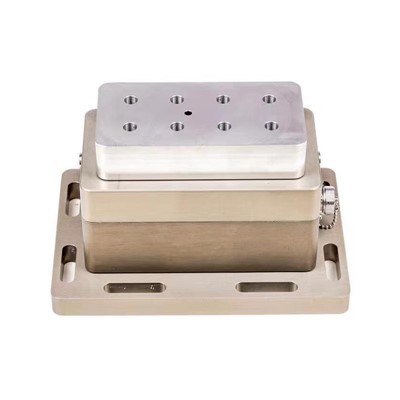
A vibrating table device for ultrasonic vibration auxiliary machining. The vibrating table device comprises a vibrating table body, a piezoelectric ceramic vibrator and a vibration membrane. The top of the vibrating table body is sealed by the vibration membrane. The interior of the vibrating table body is of a cavity structure. The piezoelectric ceramic vibrator is axially arranged in the cavity structure and makes contact with the vibration membrane. The vibrating table device has the beneficial effects that the device is convenient and easy to use, modular and miniature; the amplitude and the frequency can be adjusted through piezoelectric ceramic according to actual requirements; transitional connecting boards are arranged to achieve the protection effect and assembly and disassembly are quite easy and convenient; compared with an existing vibration manner performed through a spindle, the vibrating table device is simple and low in cost, and a machine tool is not affected.
Advantages of Ultrasonic Vibration Tables
High screening precision
The screening method combined with ultrasonic vibration tables and rotating sieve body is adopted, and the screening precision is as high as 99%.
Fast screening speed
Fast screening speed can greatly improve production efficiency.
Low noise
The ultrasonic vibration tables adopts imported components, which has high efficiency, stable vibration performance and low noise.
Less energy consumption
Energy-saving motors, ultrasonic vibration tabless and other equipment are used, which consume less energy and have the advantages of energy saving, environmental protection, and safety.



Why Choose Us
Our Factory
The company has assembled top industry technical talents along with seasoned marketing and management professionals. Leveraging cutting-edge proprietary core technologies, it specializes in researching, developing, and selling high-performance power ultrasonic core components and related complete sets of equipment. With around 2000 square meters of research and production facilities, the company possesses a well-equipped testing center capable of conducting more than 120 types of tests in six categories.
Our Certificate
National high-tech enterprise; GB/T19001-2016/ISO9001:2015 quality management system certification; 23 patents and 3 software copyrights granted.
Production equipment
Three-axis machining center, CNC lathe, high-temperature aging furnace, ultrasonic component analyzer, high-precision oscilloscope, power analyzer, cavitation intensity measurement instrument, spectrum analyzer, laser particle size analyzer, digital bridge, infrared thermal imaging instrument, microscope, laser vibrometer, etc.
Production market
The company's products are widely used in various industries such as new materials, fine chemicals, automotive, and new energy. Since its establishment, it has achieved cumulative sales of over 45 million RMB.
Vibration analysis of various machines is a powerful diagnostic tool enabling to evaluate a dynamic behaviour and the status of the object under a test. For this purpose it is necessary to measure instant amplitudes and phase of vibrations of the surface of the investigated object. The measurements may be performed by various sensors, such as piezoelectric accelerometers, electromagnetic sensors, fixed to the vibrating surface. Most of the sensors measure acceleration or a vibration velocity, but not an absolute displacement of the vibrating surface. The most attractive are sensors, which used non-contact techniques. We have developed an ultrasonic sensor enabling to perform absolute measurements of surface displacements (vibration) by means of high frequency ultrasonic waves.
For ultrasonic based measurement of vibrations different physical phenomena are used. The Doppler effect is exploited for the measurement of high frequency vibrations, but it can not be used for measurement of low frequency vibrations or displacements. The Doppler frequency shift, created by vibration of the surface under test depends on a frequency of vibration. The ultrasonic techniques, based on a phase-locked loop are used for measurement of surface displacements in short range of vibrations. The single transducer for transmitting and receiving of ultrasonic waves is used in this case. Disadvantage of this technique is a low resolution and sensitivity because of slow phase changes. Objective of this investigation was development and analysis of a sensitive ultrasonic measurement method, suitable for measurement of static displacements and low frequency vibrations.
Principle of operation of the ultrasonic sensor is based on an interference phenomenon of continuos harmonic ultrasonic waves between a vibrating surface and the ultrasonic pick-up. The sensor consists of transmitting and receiving ultrasonic transducers, an exciting electric generator and a phase locked loop. Due to multiple reflections in the air gap between transmitting and receiving transducers a standing wave is created. Measurement of vibrations is based on tracking the selected interference peak, which is carried out by means of the phase-locked loop. The transducer, used for radiation of ultrasonic waves, is fixed on the surface under a test and moves together with the surface. The receiver of ultrasonic waves is fixed on a rigid surface.
If the period of the measured vibrations is much longer then the propagation time of ultrasonic wave in the air gap, then it is possible to assume that during the measurement the transfer function is time independent, that is, its value at the given time instant t=tm depends only on the "frozen" distance z(tm). The normalised transfer coefficient of the air gap is presented. The transfer coefficient was normalised with respect to the transfer coefficient of the gap when no standing wave exists. The position and separation of periodic resonances depends on the distance between transducers and an ultrasound velocity in air. When the distance between transducers fulfils the condition: where f1 the fundamental resonance frequency of air gap, the received ultrasonic signal obtains a maximal value. Note that the values of the transfer coefficient at the resonant peaks indicate the quality of the acoustic resonator, consisting of the air gap between ultrasonic transducers and the reflecting surfaces of these transducers. The higher the quality of the resonator, the higher sensitivity may be obtained. In the vicinity of such a peak, not only the amplitude, but also the phase of the received signal depends on the distance between the transmitter and the receiver. In the developed meter the frequency of the exciting signal is adjusted in such a way that the phase difference between transmitted and received signal is kept constant. That is accomplished by means of the phase locked loop, which consists of the phase detector and voltage controlled oscillator.
Ultrasonic Vibration Tables Device for Ultrasonic Vibration Auxiliary Machining




Vibration machining refers to the processing method of the low amplitude vibrations imposing certain frequency on cutter or workpiece.Vibration machining comprises hyperfrequency ultrasonic vibrating machining and low-frequency vibration processing.What require along with product quality improves constantly, the variation of material to be processed, and the miniaturization of some machining feature, precise treatment, vibration secondary process, it is more and more that especially ultrasonic vibration secondary process has been applied.Relative to tradition processing, in milling, vibration secondary process can reduce cutting force, improves the crudy on milling surface; In Drilling operation, ultrasonic vibration secondary process effectively can improve sliding phenomenon when cutter enters to bore, under the operating mode of particularly holing on curved surface and inclined-plane, contribute to improving boring positioning precision, reduce the cutting force in drilling process simultaneously, improve crudy and the machining accuracy in hole, extend cutter life.On the other hand, using miniature Digit Control Machine Tool has become a kind of trend in the Precision Machining of miniature parts minutiae.Relative to traditional machining tool, miniature numerical control machine volume is little, consumes energy low, but it is little also to there is itself processing space, be difficult to the shortcomings such as the auxiliary equipment of placement large volume, and consider the integral rigidity requirement of fine lathe, too complicated change should not be made to its body construction.
Vibration platform apparatus for ultrasonic vibration secondary process provided, solve the installation question of the ultrasonic vibration generation equipment in the application problem of the vibration aided machining processes on fine precision process equipment or little space, there is summary, modular feature.Vibration puts on the workpiece that is arranged on this shake table by the present invention, for providing longitudinal vibration, and simple, quick detachable installation; Application the present invention, in micro-milling or the processing of micro-brill, effectively can solve a processing difficult problem for deep hole, song/beveled aperture, fine thin muscle, simultaneously can Real-Time Monitoring working angles, optimization processing technology.
Ultrasound and Vibration Analysis: Ultrasonic Vibration Tables
Vibration analysis is an incredible tool: it detects and measures small vibrations and what is causing them, allowing maintenance professionals to detect early failures. Furthermore, vibration analysis gives us a deep diagnostic and allows us to identify the failure’s root cause. Plus, there is a great number of vibration sensors and solutions in the market to choose from. Ultrasound is considered by many the first line of defence when it comes to bearing failures, since it can give a very early warning of a potential problem, even with lubrication issues. The way ultrasound does that is by monitoring the friction levels on rotating equipment. Friction creates ultrasound emissions that can be picked up by an ultrasonic handheld device or sensor and translated to low frequency sounds that the inspector can hear.
Vibration analysis is extremely complete and will give maintenance professionals a deep overview of the issue and its root cause. Almost as if ultrasound is the doctor who detects the problem, and vibration is the health specialist that will diagnose it properly. We will focus on where, in general, ultrasound can be used instead of vibration. Slow speed bearings are difficult to monitor. Since they rotate very slowly, it’s difficult for vibration sensors to pick up significant changes in vibration. Even with an ultrasound instrument it may be difficult to pick up failures if we rely only on decibel levels, since in extreme slow speed bearing applications the bearing will produce little to no ultrasonic noise. However, high-end ultrasonic devices will allow for sound recording – by recording the sound of the bearing and checking it in a spectrum analysis software, we can easily find peaks in the sound spectrum amplitude, indicating a fault.
For a maintenance professional to properly work with vibration analysis, significant training and experience are needed. On the other side, ultrasound has a much quicker learning curve: since it is monitoring friction levels and translating them to dB values, we can easily check for potential problems. Because ultrasound is based on the friction levels, it is perfect for bearing lubrication. Is the bearing lacking lubrication? Then the friction levels will increase, and we can hear that through the ultrasonic instrument and see it in the dB levels. If we start lubricating the bearing, most likely we will see a decrease in the sound intensity and the dB levels. Did the bearing receive too much lubricant? Then again, friction levels will increase, and we will know that using the ultrasonic instrument. While vibration analysis is an extremely powerful tool, its uses are limited to mechanical equipment. On the other hand, ultrasound has a wide range of applications. One of the most popular applications is energy savings. Since turbulence also creates ultrasound emissions, the ultrasonic instruments can be easily used for leak detection (compressed air and other gases), steam traps inspection and even for electrical inspections.
Important Ultrasonic Vibration Tables Considerations
Power Options
Your power source will directly impact the type and intensity of work your table can perform. Electric vibrators use an electric motor to produce horizontal, vertical and up-and-down ultrasonic vibration tabless. These systems are cost-effective and long-lasting, with a wide variety of available options to suit many different applications. A pneumatic vibrator converts potential energy from compressed air into mechanical energy, which powers the table’s ultrasonic vibration tabless. Although they are more sensitive to environmental changes, they’re quiet and low-maintenance. Most of the time, the type of power source you should use depends on your available resources. Does your facility have access to compressed air? If not, an electric motor is a more practical choice. If yes, you have more flexibility with your options.
Load Capacity
The most important ultrasonic vibration tables table consideration is its load capacity, or the amount of weight it can withstand during operation. You need to choose a table with a high enough load capacity to safely handle your materials repeatedly over the course of your typical workday. For most industrial ultrasonic vibration tables tables, load capacity typically ranges between 200 to 4,000 pounds. However, highly specialized tables may have capacities outside this range.
Ultrasonic vibration tables table types
A ultrasonic vibration tables table has a very specific purpose — to apply linear ultrasonic vibration tables to objects on its surface. In order to ensure the best possible results for each specific use, manufacturers have created multiple different configurations and designs. Assess the different tables according to your application so you can ensure optimal performance and results.
Our factory
Resonance Technology (Ningbo) Co. Ltd, founded in December 2019 with a registered capital of 10 million RMB, is located in the High-tech Zone Ningbo, China. The company has assembled top industry technical talents along with seasoned marketing and management professionals. Leveraging cutting-edge proprietary core technologies, it specializes in researching, developing, and selling high-performance power ultrasonic core components and related complete sets of equipment. The company's products are widely used in various industries such as new materials, fine chemicals, automotive, and new energy. Currently, the company has mastered core technologies in power ultrasonics including control algorithms, power amplification, drive matching, high-power transducer, and vibration system design. Its products have reached international leading levels, with over 40 patent applications and 23 patents granted. We have obtained the GB/T19001-2016/ISO9001:2015 quality management system certification. With around 2000 square meters of research and production facilities, the company possesses a well-equipped testing center capable of conducting more than 120 types of tests in six categories including physical performance, mechanical performance, environmental testing, simulation testing, chemical testing, and precision measurement.

FAQ
As one of the leading ultrasonic vibration tables manufacturers and suppliers in China, we warmly welcome you to buy ultrasonic vibration tables for sale here from our factory. All customized products are with high quality and competitive price.
vibration test, ultrasonic vibration tables, vibration assisted machining